
76% of Indians May Be Vitamin D Deficient. Could You Be One of Them?

Share
India gets plenty of sunshine. So it may seem strange that vitamin D deficiency is so common here.
Yet, study after study has found that low vitamin D levels are widespread across different Indian populations. One North Indian study, for example, reported vitamin D deficiency in 76% of the people studied. Other Indian research has also found high levels of deficiency in children, adolescents and adults. The exact percentage varies depending on the population, location and definition of deficiency, but the larger picture is difficult to ignore: having plenty of sunlight does not automatically mean having enough vitamin D.
And that raises an important question:
If the sun is everywhere, why are so many people still low in vitamin D?
Sunshine Is Not the Whole Story
Vitamin D is different from most nutrients because our body can produce it when bare skin is exposed to UVB radiation from sunlight.
But simply stepping outside for a few minutes does not guarantee adequate vitamin D production.
How much vitamin D your body makes depends on several factors, including how much skin is exposed, the intensity of sunlight, the time of day, season, age, skin pigmentation and how often you get meaningful sun exposure. Spending most of the day indoors, covering most of the skin or having limited outdoor exposure can all reduce vitamin D production.
And this is where modern lifestyles create an interesting contradiction.
We may live in a country with abundant sunshine, but many of us spend our days inside offices, homes, cars and classrooms. We leave home in the morning, spend hours indoors and return after sunset. In other words, living in a sunny country and getting enough vitamin D are two different things.
Why Does Vitamin D Matter?
Vitamin D is best known for its role in maintaining healthy bones.
It helps the body absorb calcium and maintain the calcium and phosphate levels needed for normal bone mineralisation. It also plays an important role in normal muscle function and several other processes in the body.
When vitamin D levels become too low, the effects may not always be obvious immediately.
Some people may experience muscle weakness or bone pain, while others may have no noticeable symptoms at all. That is one reason vitamin D deficiency can easily go unnoticed.
Instead of assuming that tiredness, aches or low energy are automatically caused by vitamin D deficiency, the more sensible approach is to look at the bigger picture and, when appropriate, check your vitamin D status through a blood test.

The Vitamin D Test That Actually Tells You Something
If you are concerned about your vitamin D level, guessing is not particularly useful.
The standard blood marker used to assess vitamin D status is 25-hydroxyvitamin D, or 25(OH)D. A blood test can help determine whether your level is adequate, insufficient or deficient and whether supplementation may be appropriate.
This is especially relevant for people who spend very little time outdoors, older adults, people with darker skin, people with certain digestive or fat-absorption problems, and people who may have other risk factors for low vitamin D.
So before thinking about taking more and more vitamin D, it is worth knowing where you actually stand.
Food, Sunlight and Supplements: Where Does Vitamin D Come From?
There are three main ways we get vitamin D: sun exposure, food and supplements.
Unfortunately, naturally occurring vitamin D is found in relatively few foods. Fatty fish are among the better natural sources, while smaller amounts can be found in foods such as egg yolks and cheese. Some foods are also fortified with vitamin D.
For people who do not get enough vitamin D through their usual lifestyle and diet, supplementation can be a practical option.
But supplementation is not simply about choosing a higher number on the label.
The form in which you take a nutrient also matters to the overall experience.
Tablets Aren't the Only Way to Supplement Vitamin D
For years, vitamin D supplementation has largely meant capsules or tablets.
They remain a perfectly established way of taking vitamin D. In fact, vitamin D is absorbed in the small intestine, and absorption can be improved when it is taken with a meal or snack containing some fat.
However, not everyone enjoys swallowing tablets every day.
Some people simply prefer a format that is quicker, easier and more convenient to fit into their routine. This is where oral sprays offer an interesting alternative.
A vitamin D spray can be taken without water and without having to swallow another tablet. For people who travel frequently, have busy mornings or simply dislike pills, that small difference can make daily supplementation easier to maintain.
What Does Sublingual Vitamin D Mean?
Sublingual means under the tongue.
Instead of swallowing a conventional tablet, a sublingual spray is delivered into the mouth, where it can interact with the tissues of the oral cavity.
There is research exploring oral and sublingual spray formulations of vitamin D. Clinical studies have shown that vitamin D delivered through a spray can effectively increase blood 25(OH)D levels, although current evidence does not establish that sprays are universally superior to capsules or tablets.
That distinction is important.
The real advantage of a spray is not that tablets are somehow “useless” or that every spray automatically provides dramatically better absorption. The advantage is convenient delivery in a format that some people may find easier to use consistently.
And consistency matters when it comes to any daily nutrition routine.

Why Choose a Vitamin D Sublingual Oral Spray?
If you are looking for an alternative to conventional vitamin D tablets, an oral spray can make supplementation simpler.
No Water Required
A spray can be taken without carrying a glass of water or swallowing a tablet.
Easy to Use
A measured spray can fit naturally into your daily routine, whether you are at home, at work or travelling.
Sublingual Delivery
Vitonnix uses a sublingual oral spray format, designed to deliver vitamin D through the mouth rather than as a conventional swallowed tablet.
Simple Daily Routine
The easier a supplement is to take, the easier it can be to make it part of your everyday routine.
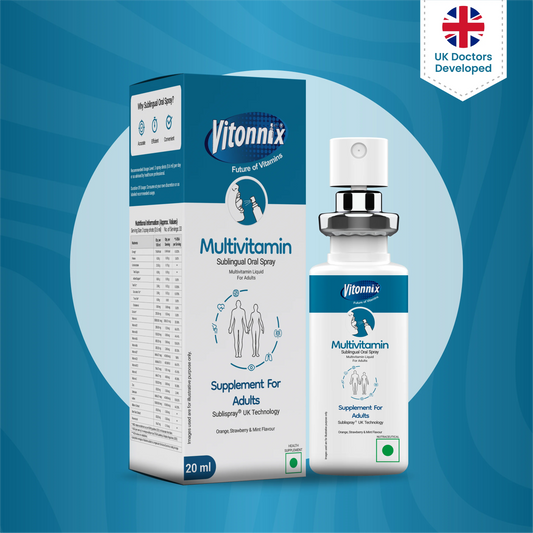
Meet Vitonnix Vitamin D2 Sublingual Oral Spray
For people who prefer a spray over traditional tablets, Vitonnix Vitamin D2 Sublingual Oral Spray offers vitamin D in a convenient sublingual format.
The idea is simple: instead of adding another tablet to your daily routine, you get vitamin D in an easy-to-use spray.
Vitonnix Vitamin D2 is designed to support strong bones and muscles while offering the convenience of a compact, travel-friendly format.
No water.
No swallowing a large tablet.
Just a simple spray that can fit into your everyday routine.
Who May Prefer a Vitamin D Spray?
A spray may be particularly appealing if you:
-
Prefer sprays over tablets or capsules
-
Find swallowing pills inconvenient
-
Have a busy daily schedule
-
Travel frequently
-
Want a simple supplement format that is easy to carry
-
Are looking for a convenient way to include vitamin D in your daily routine
Of course, the right amount of vitamin D varies from person to person. If you have been diagnosed with vitamin D deficiency, have a medical condition, take medications or are considering higher-dose supplementation, it is sensible to speak with a healthcare professional.
Don't Ignore the Basics
Vitamin D supplementation should not replace the basics of good nutrition and a healthy lifestyle.
Your body needs a combination of nutrients, adequate dietary intake, physical activity and appropriate sun exposure. And when vitamin D levels are genuinely low, identifying the reason behind the deficiency is just as important as taking a supplement.
The good news is that you do not need to make vitamin D complicated.
Know your levels.
Understand your needs.
Choose a format you can use consistently.
The Takeaway
Vitamin D deficiency is not simply a problem of people who live in places with little sunlight. India has plenty of sunshine, yet research has repeatedly shown that low vitamin D levels can be common in Indian populations.
Our indoor lifestyles, limited sun exposure, diet and individual differences can all play a role.
If you are looking for a convenient alternative to traditional vitamin D tablets, a sublingual oral spray can be a practical addition to your daily routine.
Because getting the right nutrient is important. But making it easy to take consistently is important too.