
Age-Related Macular Degeneration (AMD): Prevention Starts Earlier Than You Think

Share
As a food technologist who has spent years examining how nutrients move from plate or bottle to biological systems, I have watched age-related macular degeneration shift from a distant concern of the elderly to a pressing reality for people still in their productive years. The macula, that tiny central region of the retina responsible for sharp, detailed vision, does not suddenly fail at sixty-five. Its decline is the cumulative result of oxidative stress, light exposure, and nutritional shortfalls that begin much earlier. Understanding this process, and intervening intelligently, is no longer optional.
What Exactly Is Age-Related Macular Degeneration?
The Role of the Macula
The macula is the central part of the retina densely packed with photoreceptors that enable sharp vision for reading, recognising faces, and driving. When these cells are damaged over time, central vision becomes blurred or distorted while peripheral vision usually remains intact.
Dry and Wet Forms
Dry AMD, the more common form, involves gradual build-up of yellowish deposits called drusen and progressive thinning of macular tissue. Wet AMD is less frequent but more aggressive; abnormal blood vessels grow and leak fluid or blood, threatening central sight more rapidly. Both forms share the same underlying vulnerability: the macula's high metabolic demand and constant light exposure make it highly susceptible to oxidative damage.

Why AMD Is No Longer Just an "Old Age" Problem
Changing Patterns of Onset
Cases are appearing earlier, with people in their forties and fifties increasingly showing early macular changes once seen decades later. Prolonged screen time, elevated blue-light exposure, urban pollution, and diets low in protective carotenoids have accelerated the timeline.
Lifestyle and Nutritional Drivers
Genetic predisposition still plays a role, yet lifestyle and nutritional factors now speed up the process significantly. From a food-technology viewpoint, modern diets frequently fail to supply the concentrations of lipid-soluble antioxidants the macula needs, while simultaneous stressors raise the demand for those same compounds.
The Science of Macular Damage: What Happens Inside the Eye
Oxidative Stress in a High-Demand Tissue
Photoreceptors and the retinal pigment epithelium function in an oxygen-rich, light-saturated environment. Reactive oxygen species generated by normal metabolism and high-energy blue light attack the polyunsaturated fatty acids in cell membranes.
Decline of Natural Protection
Over years this oxidative burden depletes the macular pigment, mainly lutein and zeaxanthin that normally filters short-wavelength light and neutralises free radicals. When macular pigment density falls, inflammation and cellular debris accumulation accelerate. The process is gradual and largely silent until functional thresholds are crossed and central vision begins to decline.
Key Nutrients That Support Macular Health
Core Protective Carotenoids
Lutein and zeaxanthin are selectively concentrated in retinal tissue and form the bulk of the macular pigment; their structure allows both light filtration and antioxidant activity. Research has linked higher dietary intake of these two carotenoids with meaningfully lower risk of advanced AMD, which is why eye-health formulations tend to anchor around them rather than treating them as one ingredient among many. Astaxanthin, a more potent carotenoid, crosses the blood–retina barrier and offers additional protection against lipid peroxidation.
Supporting Antioxidants and Extracts
Vitamins C and E help regenerate other antioxidants and stabilise cell membranes. Polyphenolic extracts from bilberry and pine bark support the modulation of inflammatory pathways. The real challenge lies not only in identifying these molecules but in ensuring they reach the target tissue in meaningful quantities on a consistent basis.

Why Traditional Tablets Often Fall Short
Absorption Barriers
Carotenoids are highly fat-soluble and require adequate dietary fat, bile salts, and efficient digestive function for proper absorption. First-pass metabolism in the liver further reduces the amount that reaches systemic circulation. Many people especially those with age-related digestive changes or those taking multiple medications absorb only a fraction of the labelled dose.
Practical Limitations
Large tablets and the need to remember daily intake with meals frequently lead to inconsistent use. From a formulation perspective, the gap between the nutrient present in a tablet and the nutrient arriving at the retina can be substantial.
The Advantage of Sublingual Delivery for Eye Nutrition
Bypassing Digestive Limitations
Sublingual administration bypasses the gastrointestinal tract and hepatic first-pass effect. The thin, richly vascularised mucosa beneath the tongue allows rapid diffusion of suitably formulated actives directly into the bloodstream.
Improved Consistency and Convenience
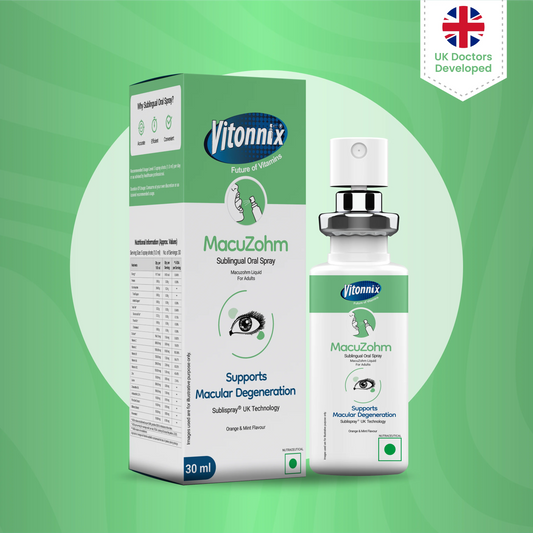
When lutein, zeaxanthin, astaxanthin and supporting antioxidants are presented in a carefully designed spray matrix, absorption becomes both faster and more predictable. The format eliminates the need to swallow large tablets, offering practical convenience for older adults and anyone seeking ease of use. Vitonnix MacuZohm Sublispray was built around exactly this gap: a sublingual carrier designed to move these fat-soluble actives past the digestive bottlenecks that limit conventional tablets, so consistent daily use translates into consistent daily intake — not just a consistent daily habit.
Building Prevention Into Daily Life
The most effective window for action begins well before clinical signs emerge ideally in your forties, or earlier if you carry risk factors such as a family history of AMD, prolonged occupational screen use, smoking, or a diet chronically low in colourful plant foods. A few habits compound well together:
-
Manage light exposure: follow the 20-20-20 rule (every twenty minutes, look at something twenty feet away for twenty seconds), and wear sunglasses that block UV and a portion of blue light.
-
Build a protective baseline through diet: dark leafy greens, orange and yellow vegetables, and oily fish all raise intake of the compounds above.
-
Monitor structurally, not just symptomatically: regular comprehensive eye exams catch changes long before they're felt.
-
Close the gap with high-bioavailability supplementation: this is what bridges an imperfect diet and the elevated visual demands of modern life and why the delivery format matters as much as the ingredient list.
Once significant photoreceptor loss has occurred, regeneration is limited, so the realistic goal is preservation, not repair.
The Takeaway
Age-related macular degeneration is not an inevitable consequence of growing older - it is the outcome of cumulative stress meeting inadequate defence. Progress in delivery systems now allows protective nutrients to reach the retina more efficiently than ever before. Combining intelligent dietary patterns, sensible light management, and a high-absorption sublingual formula offers a practical strategy that fits contemporary life. The earlier these measures become routine, the greater the likelihood of preserving the sharp, central vision that underpins independence and quality of life for decades to come.